
Dtransfer Fellowship Teaching
Ebenezer
If you have begun to believe that the flesh must always rule you, bring that conclusion before the gospel. The sin you fear is not greater than the saving help God has provided. Look to Christ. Receive His Word. Take the next step of obedience in dependence upon His Spirit.
The Help of God and the Freedom We Have in Christ
“Hitherto hath the LORD helped us.” — 1 Samuel 7:12
Recently, while prayerfully preparing to teach a group of Americans, I felt a burden in my heart concerning a memorial unto the name of the Lord. As I prayed with my wife, the word Ebenezer kept coming to mind. I began to sing a song I knew about Ebenezer, our stone of help. Yet the burden remained with me until I arrived at the place where I was to teach.
I was reminded of Moses turning aside to see the bush that burned without being consumed. Exodus 3:4 tells us that when the Lord saw that Moses turned aside, He called to him. I sensed a need to give attention to what was pressing upon my heart and bring it before the Scriptures. I explained this to the group, and we began reading 1 Samuel 7 from beginning to end, asking the Lord to help us understand.
As we read, I began to see a connection between the help commemorated at Ebenezer and the saving help God has given us in Jesus Christ. The account led me to Numbers 21, then to the words of Jesus in John 3, and to the cry for deliverance at the end of Romans 7.
The burden became clearer: the Lord Himself is our help. He has provided in Christ what we could never produce by the strength of the flesh, and by His Spirit He enables us to live in the freedom His Son has secured.
This is the testimony I want us to consider. We have been helped by God, and His help reaches into the very place where sin once held us captive.
The help remembered at Ebenezer
The stone in 1 Samuel 7 stands at the end of a story of repentance, fear, sacrifice, prayer, and divine deliverance. To understand the memorial, we must first hear the account.
Israel had spent years lamenting after the Lord. Samuel called the people to return to Him with all their hearts, put away their strange gods, and serve Him only. They responded by putting away Baalim and Ashtaroth. At Mizpeh, they fasted and confessed that they had sinned against the Lord. Their need was deeper than an invading army. Their hearts had wandered from the God who had called them His own (1 Samuel 7:2–6).
Then the Philistines came against them. The people who had gathered to seek God suddenly found themselves afraid. Turning to the Lord had not prevented an enemy from approaching. But in their fear, they asked Samuel to keep crying to God for their deliverance.
Samuel took a suckling lamb and offered it wholly to the Lord as a burnt offering. He cried to the Lord for Israel, and the Lord heard him. As Samuel offered the sacrifice and the Philistines drew near, the Lord thundered against them and threw them into confusion. The men of Israel then went out, pursued them, and struck them down (1 Samuel 7:7–11).
Notice the order. Israel’s pursuit followed the Lord’s intervention. Their activity was real, but the decisive help came from God. They cried to Him, He acted on their behalf, and they went forward in the help He supplied.
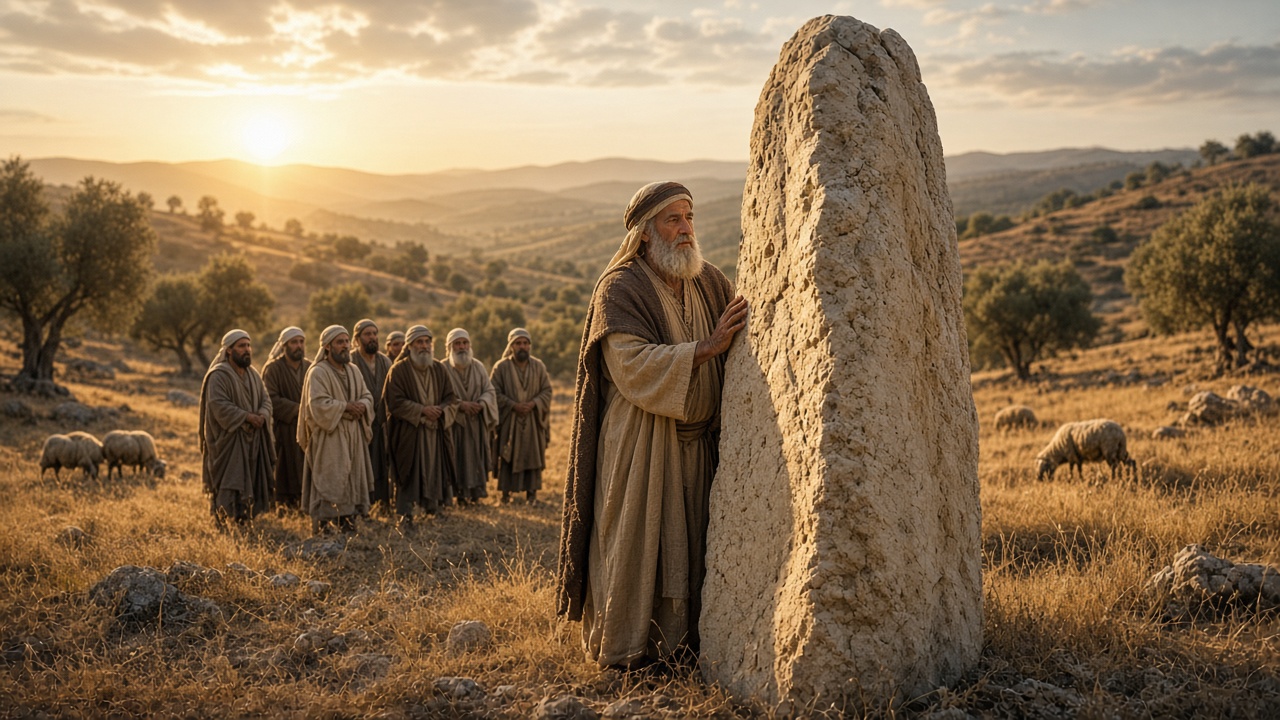
Afterward, Samuel raised a stone and named it Ebenezer, meaning “stone of help.” His explanation gave the glory to the Lord: “Hitherto hath the LORD helped us.”
The stone bore witness to what God had done. The chapter continues with subdued enemies, restored territory, peace with the Amorites, and Samuel’s continuing ministry among the people (1 Samuel 7:12–17). God’s help had made a difference in their life together.
This is the sense in which I see Ebenezer as a memorial of grace. Its name means “stone of help”; the event it commemorates displays God’s merciful help to people who had sinned, returned to Him, and depended upon Him. In the gospel, we see the fullest expression of that saving grace in Jesus Christ.
The Lamb before the pursuit
The lamb in this account arrested my attention. Before Israel went out in pursuit, Samuel offered a lamb wholly to the Lord and interceded for the people. Deliverance came in the setting of sacrifice and prayer.
First Samuel 7 does not explicitly identify Samuel’s lamb as a prophecy of Jesus. Yet, read alongside the wider Scriptures, it gives us a fitting picture to contemplate in the light of Christ. The burnt offering was wholly given to God, and Leviticus 1:4 connects it with atonement. John the Baptist identifies Jesus as the Lamb of God who takes away the sin of the world (John 1:29). Paul describes Him as giving Himself for us, an offering and a sacrifice to God (Ephesians 5:2).
The Christian application therefore rests upon what the New Testament plainly declares: Jesus gave Himself for our sins, and He lives to intercede for those who come to God through Him (Hebrews 7:25–27).
We must see the sufficiency of the Lamb. His sacrifice does not await completion by our religious effort. His offering was once for all (Hebrews 10:10–14). Our obedience proceeds from the mercy we have received through Him.
This matters when sin has made a person afraid. Repeated defeat can persuade us that an appetite, a temper, a resentment, or a secret practice is stronger than any help available to us. We may begin to regard bondage as our permanent condition.
But the gospel directs our eyes to the Son whom God has given. Before we measure the strength of our resolve, we need to understand the ground on which we stand before God.
In Christ, that ground is His finished sacrifice. The One who died for us has risen, and His life is our hope.
Life provided in the place of death
Numbers 21 brings us to another scene of helplessness. Israel became discouraged on the journey and spoke against God and Moses. The Lord sent fiery serpents among the people, and many died. These serpents were an instrument of judgment upon their rebellion. The people confessed their sin and asked Moses to pray that the Lord would remove them (Numbers 21:4–7).
Moses prayed, and God provided a remedy. He instructed Moses to make a serpent and lift it upon a pole. Whoever had been bitten could look at it and live. Moses made the serpent of brass, and the bitten person who looked lived (Numbers 21:8–9).
The remedy came from the very God against whom they had sinned. The account does not say that He first removed every serpent. It tells us that He provided life for those who looked. While death was a present reality among them, God had appointed a means by which they could live.
There is a shared pattern with Mizpeh: sin is confessed, an intercessor prays, and people in danger receive help from God. The circumstances differ. At Mizpeh, Israel pursued an invading army after the Lord intervened. In the wilderness, those under judgment lived by looking at the remedy He supplied.
Neither passage directly identifies the Philistines or the serpents as “the flesh.” They can, however, help us understand the danger and helplessness from which we need deliverance considering both philistines and the serpent as a type of the flesh in action in the light of Romans 8:1-4 and John 3:14-16. The New Testament reveals how Christ answers our deepest need.
A bitten Israelite could not reverse the poison by regretting the bite. Likewise, recognizing the damage sin has done does not give us power to save ourselves. Confession brings our need into the light. Faith receives the remedy God supplies.
The Son of Man lifted up
Jesus Himself establishes the connection between the wilderness serpent and His saving work:
“And as Moses lifted up the serpent in the wilderness, even so must the Son of man be lifted up: That whosoever believeth in him should not perish, but have eternal life.” — John 3:14–15
Jesus directs Nicodemus from the lifted serpent to the Son of Man who must be lifted up. John later explains this language in relation to the death Jesus would die (John 12:32–33).
In the wilderness, a dying person looked and lived. In the gospel, the person who believes in the crucified Son receives eternal life. The connection concerns God’s appointed provision and the response of faith. Jesus remained the sinless Son who bore our sins in His own body on the tree (1 Peter 2:22–24).
Then comes the great declaration of John 3:16: God loved the world and gave His only begotten Son so that whoever believes in Him should not perish but have everlasting life.
This is the love behind the provision. God has come to our aid at a cost we could never have paid.
The name Jesus carries the meaning “Yahweh saves” or “Yahweh is salvation.” Matthew 1:21 declares that He will save His people from their sins. Here the testimony of Ebenezer comes into focus for us: the Lord who helps is the Lord who saves, and His salvation reaches into the bondage of sin.
To believe in His name is to trust the Person He is and the saving work He has accomplished. We entrust ourselves to Him as the Son of God and our Saviour.
This belongs to Jesus’ teaching about the new birth. What is born of the flesh is flesh; what is born of the Spirit is spirit (John 3:6). Our need reaches beyond improved behaviour. We need life from God. The Son lifted up for us and the Spirit giving us new birth belong together in the salvation Jesus announces.
The cry that finds its answer in Christ
Romans 7 describes a captivity that good intentions cannot overcome. A law at work in the members wars against the law of the mind and brings the person into captivity to sin. The cry that follows is painfully direct:
“O wretched man that I am! who shall deliver me from the body of this death?” — Romans 7:24
The person recognizes the good yet discovers a power of sin that the recognition itself cannot overcome. Earlier, Paul describes being carnal and sold under sin (Romans 7:14). The holy commandment exposes the problem, but fallen human nature cannot supply its own cure.
Christians differ over precisely whose experience Paul describes here. Yet the truth central to this article is clear: the flesh cannot produce deliverance from sin, even when the goodness of God’s law is recognized.
The cry asks, “Who shall deliver me?” Paul answers with thanksgiving to God through Jesus Christ our Lord (Romans 7:25). Although the verse still acknowledges the conflict he has described, the passage carries us forward into Romans 8 and the ground and power of deliverance.
There is now no condemnation for those who are in Christ Jesus. The law of the Spirit of life in Christ Jesus sets free from the law of sin and death (Romans 8:1–2).
Our help has a name, and our freedom has a source.
The fear at Mizpeh, the helplessness of the bitten Israelite, and the cry of Romans 7 meet at this point: we need help that we cannot give ourselves. The circumstances differ, but the testimony of God’s provision directs our attention to Him.
What God did through His Son
Romans 8:3 explains why the answer must come from God. The law could not accomplish our deliverance because of the weakness of the flesh. God’s holy standard exposed a problem that lay in us.
God sent His own Son in the likeness of sinful flesh and for sin, and condemned sin in the flesh. The Son truly entered our humanity, yet without sin. Through His sacrificial death, God dealt with the sin that held us captive.
Verse 1 announces freedom from condemnation for those in Christ. Verse 3 declares that sin itself has been condemned in the flesh.
The passage then states God’s purpose: that the righteous requirement of the law might be fulfilled in us who walk according to the Spirit (Romans 8:4). Grace brings us into a life that expresses the righteousness God desires. His mercy calls us to holiness, and His Spirit enables our obedience.
Romans 6:6 also tells us that our old man was crucified with Christ so that we should no longer serve sin. Galatians 5:24 speaks of those who belong to Christ as having crucified the flesh with its passions and desires.
These passages give direct biblical substance to the freedom we are considering. Through our union with Christ, sin’s former mastery is no longer our rightful condition. We are to reckon ourselves dead to sin and alive to God through Jesus Christ, and yield ourselves to God (Romans 6:11–13).
Faith receives what God has accomplished and responds by presenting our lives to Him.
Temptation may still press upon us, and our bodies still await their final redemption. The body itself is not evil. The flesh, in the moral sense considered here, is human life governed by sin and opposed to God. His purpose is that our embodied lives should now serve Him.
Fighting from the victory of Christ
Here the pursuit in 1 Samuel 7 becomes a helpful illustration. The Lord threw the Philistines into confusion, and Israel went out after them. His intervention called forth their action. They had something to do because He had acted.
For the believer, Romans 8:13 states the matter plainly: through the Spirit we put to death the deeds of the body. We act, and the Spirit enables us. Dependence upon Him finds expression in obedience.
This is what I mean by fighting from victory. Christ’s completed work is the foundation of our struggle against sin. We resist as people who belong to Him, with His Spirit dwelling in us. We do not complete His atonement or earn our acceptance by winning enough battles.
When anger rises, we can refuse the cruel word and yield our speech to God. When lust calls, we can turn away, remove access to what feeds it, and seek prayer and honest accountability. When bitterness presses its claim, we can bring the wound before the Lord and obey His call to forgive. Above all we call on the name of the Lord - our stone of help. We come to face the fleshly desires in His name like David did with Goliath and the Lord sent a stone of help!! You turn to Him and look to Him by calling His name - Lord Jesus, be with my spirit, Lord Jesus help me, Lord Jesus save me. Whosoever call upon His name shall be saved. At that moment the very present help in time of trouble will show up and grace will come from His throne. Selah
These are concrete acts of faith in the help He supplies. The continuing presence of temptation does not prove that Christ has failed. Neither should we make peace with a sinful practice because the battle has been long. We may need the help of mature believers, honest confession, and patient growth in obedience. If we fall, we confess our sin and turn to the faithful Savior who forgives and cleanses. Jesus Christ the righteous is our Advocate with the Father (1 John 1:9–2:2).
The grace that saves us also teaches us to deny ungodliness and live righteously (Titus 2:11–12). Freedom becomes visible as our lives increasingly bear the character of Jesus. May we see Christ formed in His people and His life expressed across generations.
A memorial unto His name
Samuel’s stone directed Israel’s memory to the Lord. Our testimony must likewise give Him the glory. When we speak of freedom, may people see the Savior who delivered us.
We remember the Lamb who gave Himself wholly for us. We believe in the Son who was lifted up. We give thanks to the Deliverer who answers the cry of the captive. We walk by the Spirit who dwells in those who belong to Christ.
If you have begun to believe that the flesh must always rule you, bring that conclusion before the gospel. The sin you fear is not greater than the saving help God has provided.
Look to Christ. Receive His Word. Take the next step of obedience in dependence upon His Spirit.
Your history of defeat does not have the authority to overturn what God has accomplished in His Son.
Ebenezer is a fitting confession of gratitude: up to this point, the Lord has helped us. We say it with our eyes upon the crucified and risen Jesus, the greatest demonstration of His saving grace. He has come to our aid in our deepest need, and we remain dependent upon Him as we walk forward.
May our homes, our fellowship, and our daily conduct bear witness to His help. May those who see the change in us have reason to glorify His name.
Father, thank You for giving us Your Son. Teach us to rest in His finished work and to obey You through the power of Your Spirit. Deliver us from confidence in the flesh and from surrender to the sins You have called us to forsake. Let the life of Jesus be expressed in us, and let all the glory return to You. In Jesus’ name. Amen.
Your Brother in Christ,
Tunde Caleb Agboola
________________________________________
Scripture quotations are from the King James Version. Principal passages: 1 Samuel 7; Numbers 21:4–9; John 3:14–18; Romans 7:23–8:4.